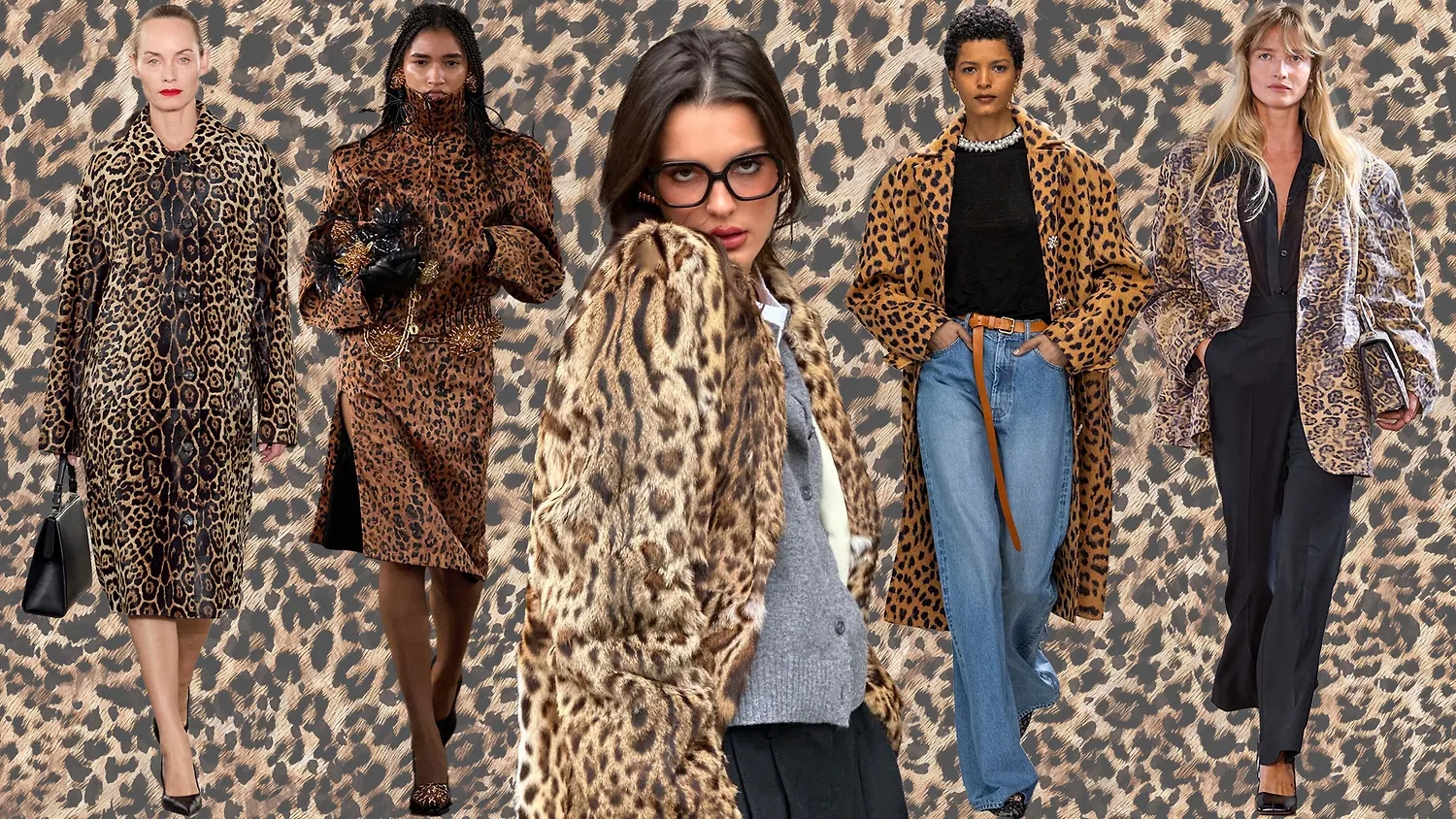
Think about the last time you got dressed to go somewhere you weren't supposed to be. Not literally, but the last time you dressed for something outside the everyday version of yourself. You know the feeling, when you’ve opted for something specific, something that signals to yourself, as much as anyone else, that tonight, the rules are negotiable.
That gesture is a lot older than you might think.
Travel back to the slopes of Mount Cithaeron, to a time of transgression. In the darkness they were called the Maenads, or the raving ones. Female followers of Dionysus, the god of wine, ecstasy and everything that existed outside the ordered life of the Greek city.
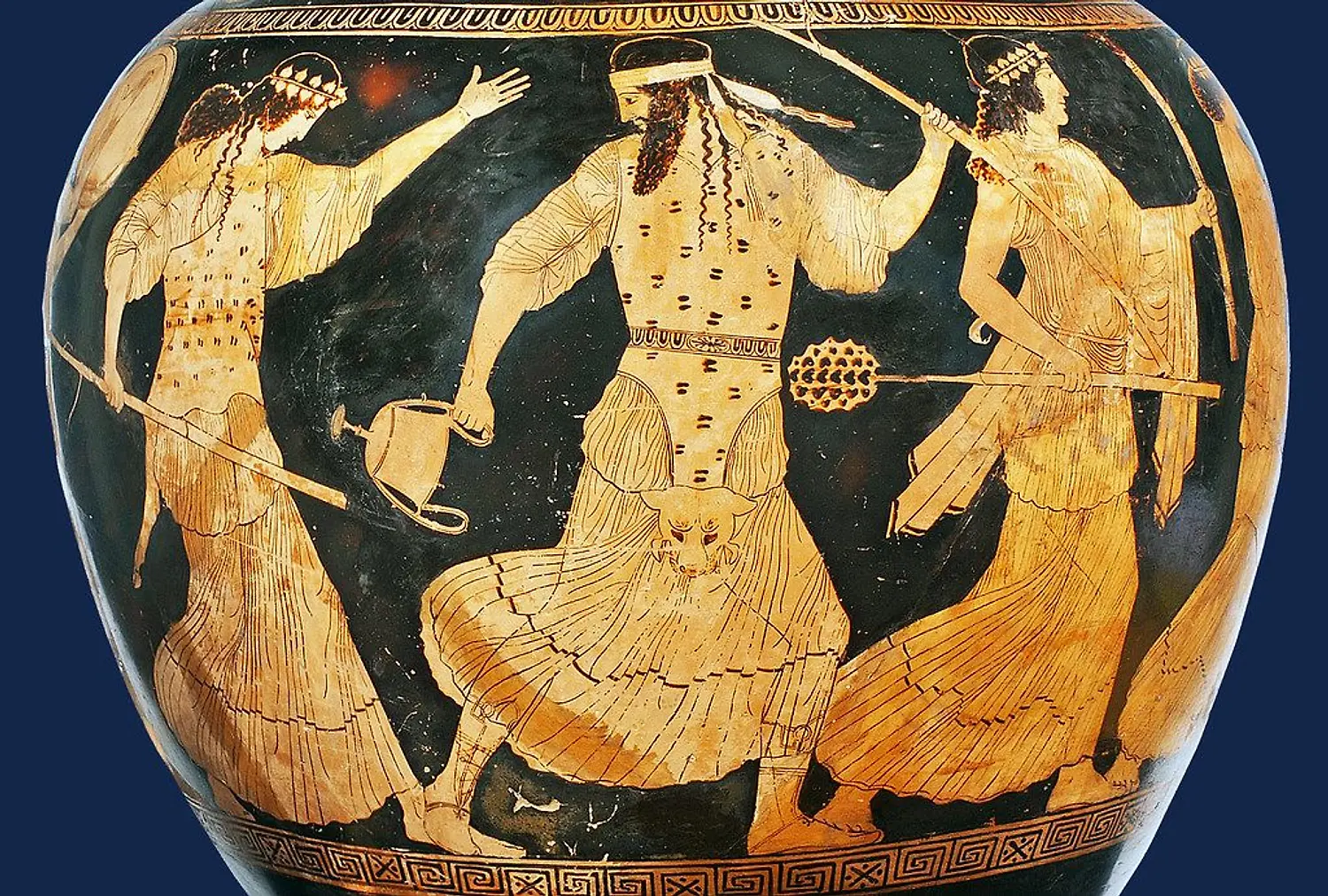 Maenads depicted on an ancient Greek vase
They left their homes and their looms, abandoning their prescribed roles and fled into the mountains. And when they went, they dressed in the hides of animals. Fawn skin, or nebris, draped across the shoulder or belted at the waist and leopard pelt thrown over the body like a cloak. Ivy wound through hair and feet bare against the rock.
Every element as deliberate as the last, a symbolic dismantling of the domestic.
The most detailed account we have comes from Euripides’ play The Bacchae, written around 405 BCE. In it, a messenger describes what he witnessed on the mountain: three bands of women lying among the fir trees, sleeping in the oak leaves, completely at rest, completely undisturbed and apparently harmless… pastoral, even.
Then they were disturbed.
They rose together, called on the god in one voice, tucked their fawn skins into their belts and girdled themselves with living snakes. They struck the ground with their fennel staffs tipped with pine cones (or thyrsi) and the earth answered with wine, milk and honey.
When the messenger was discovered, the women came after him and when they encountered cattle grazing on the hillside, they tore them apart with their bare hands.
At the centre of all of this sat the leopard skin.
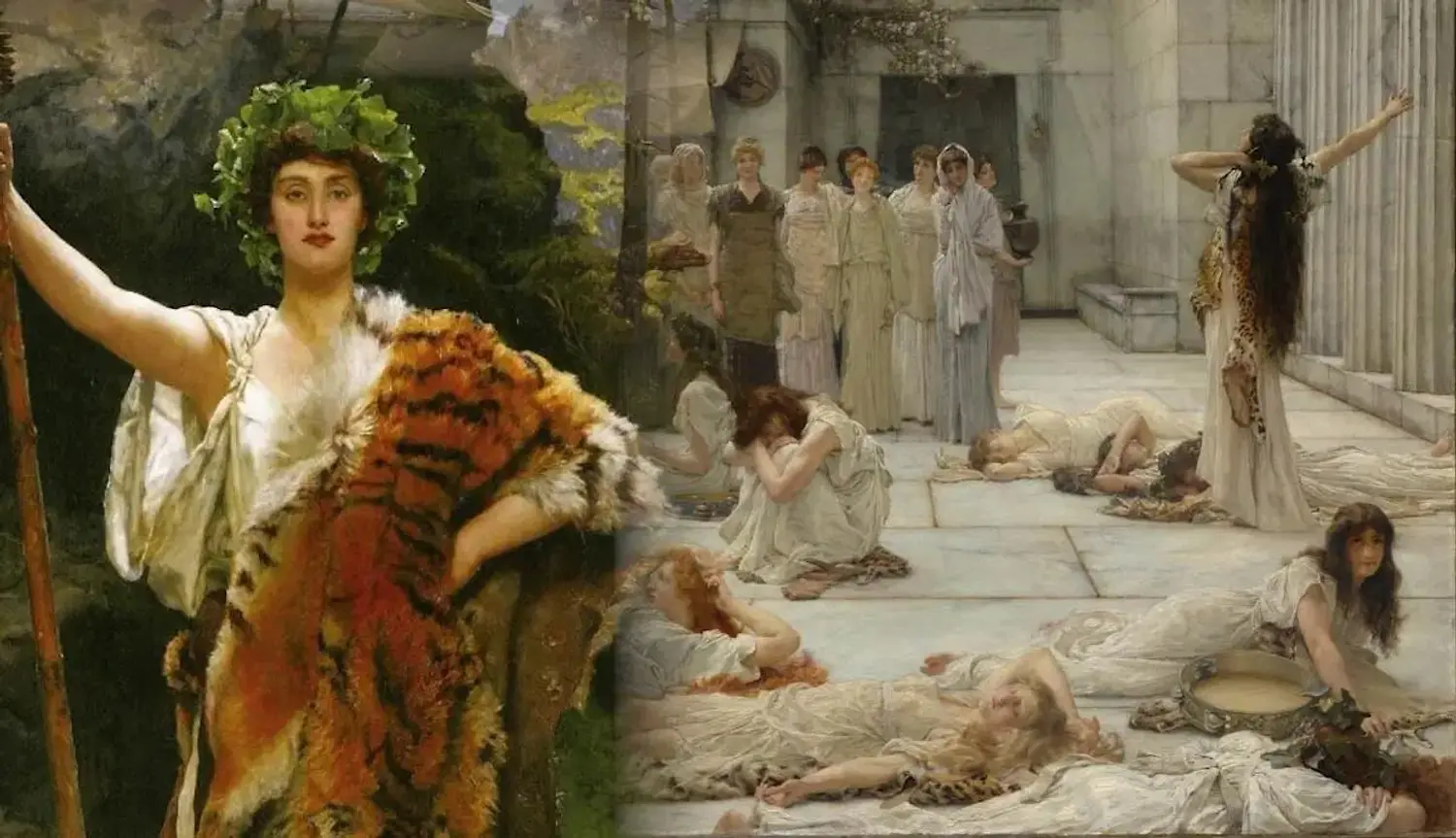 The Women of Amphissa, by Lawrence Alma-Tadema, 1817, via The Clark Art Institute; with The Priestess of Bacchus, by John Collier, 19th century
Dionysus himself was often depicted wearing it, riding leopards, surrounded by them. In the symbolic language of the ancient world the leopard occupied a very specific position of dangerous ambiguity. Neither fully wild nor fully domesticated and beautiful in a way that kept you at the edge of certainty.
The leopard was the animal of the in-between and so it was fit that the god of the in-between should claim it as his own.
Long before it appeared on runways or cinema screens, the leopard skin carried this charge and when the Maenads wore leopard, pelt they were dressing into something, taking on the qualities of the skin: its wildness, its ambiguity, its refusal to be caged or categorised. The Greeks understood then, in a ways that many have forgotten, that what you wear on your body has the power to change the body wearing it.
The fawn skin worked differently. Where the leopard carried power and unease, the nebris brought youth and the suggestion of the hunted becoming the hunter.
Worn together, these two skins created a complete vocabulary, capable of tenderness and violence. Both playful and annihilating all at once.
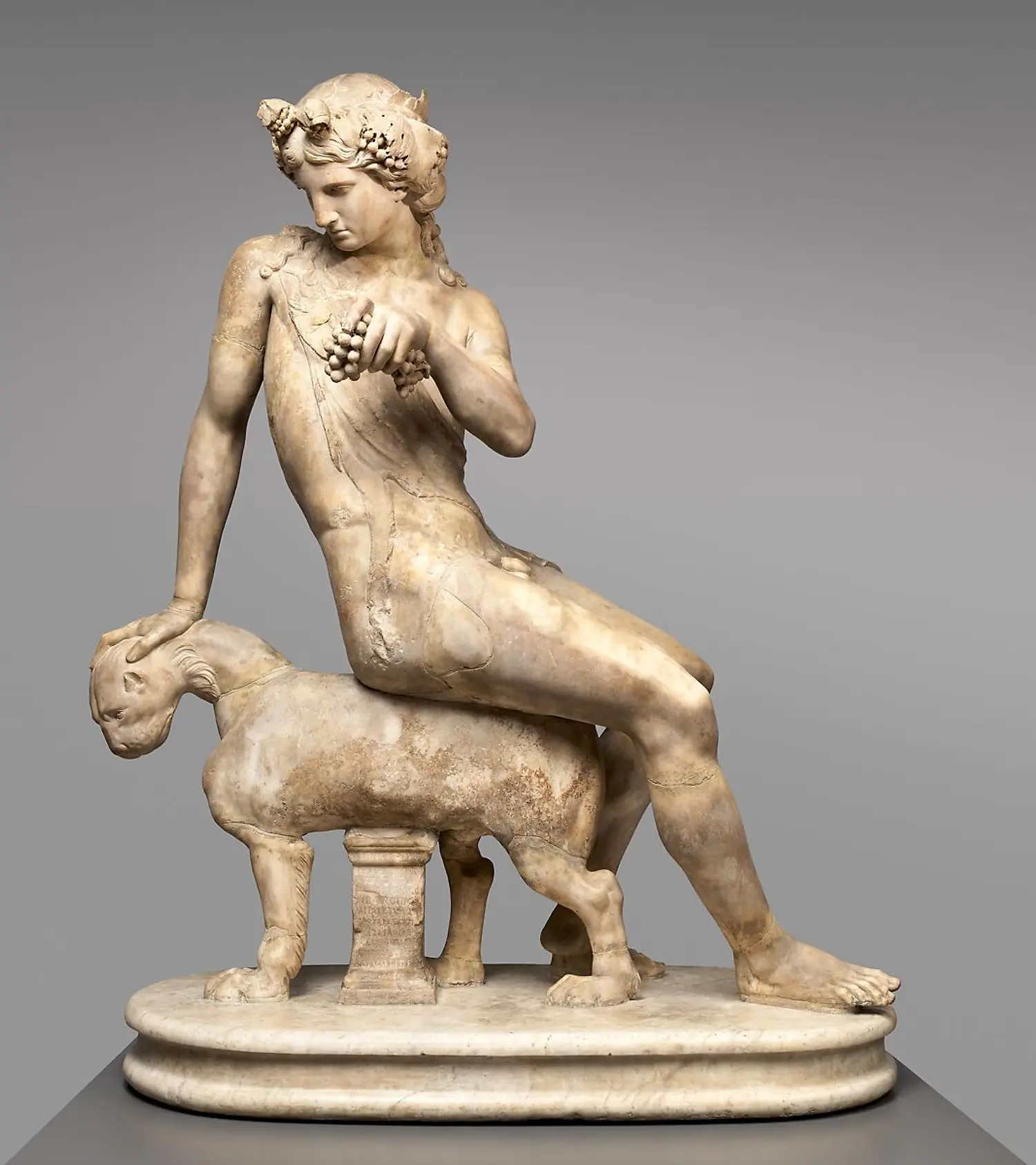 Marble statue of Dionysos seated on a panther
The Roman Senate eventually passed legislation to control Bacchic rites, suspicious of women gathering in the dark without male supervision, answering to a god who valued ecstasy over anything ordered or contrived. The fawn skin and the leopard pelt were visible from a distance and, like all symbolic dress, anyone who saw them knew exactly what they meant.
Clothing has always worked this way. Long before fashion existed as a category, dress was the technology by which people signalled allegiance, departure or indeed, transformation.
The Maenad’s leopard skin was a declaration of which side of the boundary she stood on.
The leopard, or leopard print, has never quite left this symbolic territory, even as the centuries have accumulated around it. Roman Bacchic imagery kept the pelt and its associations intact and Renaissance painters returned obsessively to the Bacchante figure - wild-haired, animal-draped, flushed with something polished courtly culture could not accommodate directly.
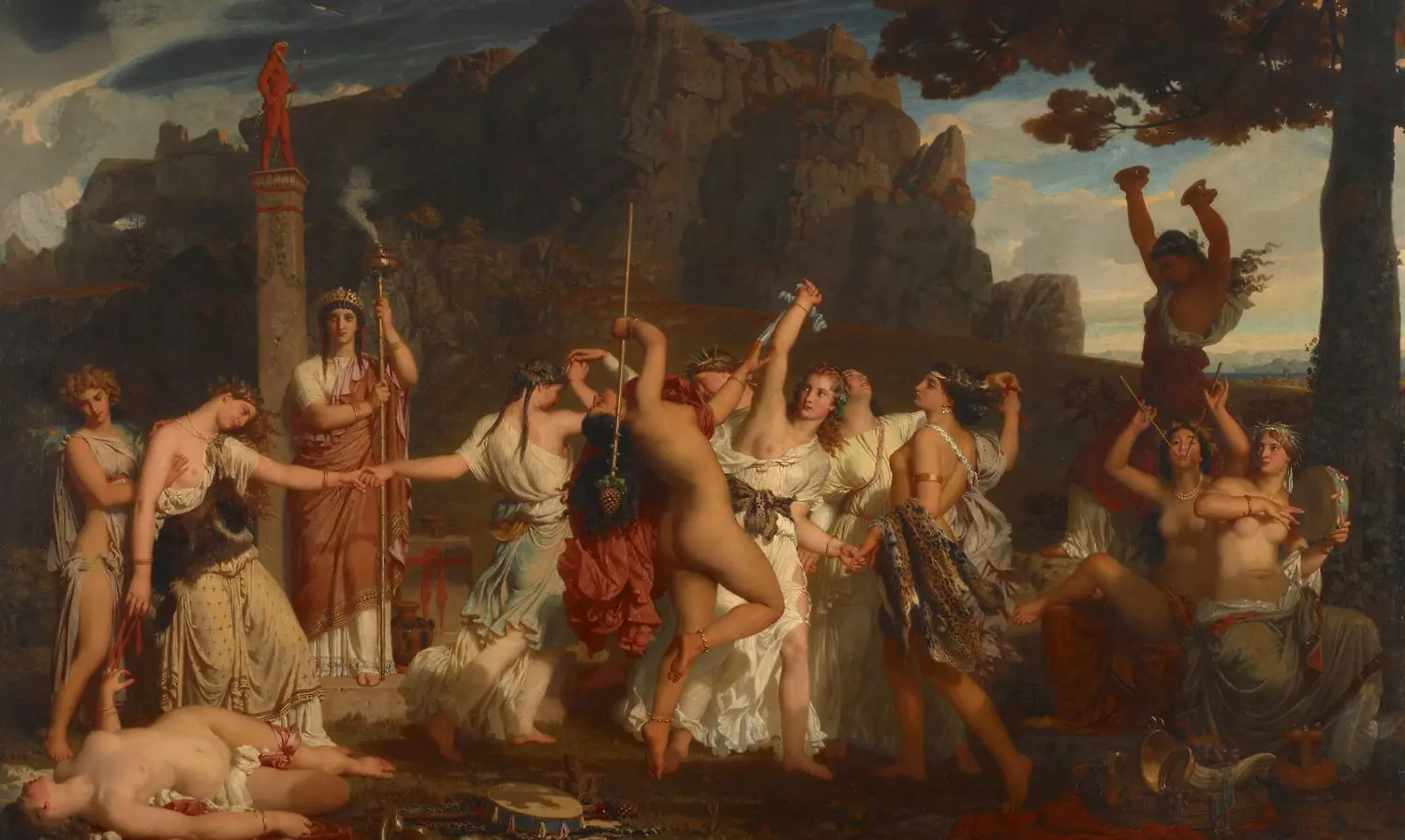 Charles Gleyre
La danse des bacchantes (The Dance of the Bacchants), 1849
Charles Gleyre
La danse des bacchantes (The Dance of the Bacchants), 1849By the time leopard print reached the twentieth century, it had shed the ritual context but kept the charge, and this could be seen on cinema and stage alike. The woman in leopard was never written as the quiet one. On screen, the pattern signalled something immediately legible: confidence, danger, independence and, occasionally, outright defiance. From Hollywood's golden age to the punk clubs of the 1970s to late-night city streets that belonged to no one in particular, leopard carried the same suggestion it always had: that the person wearing it was not especially interested in behaving. It became the mark of a woman who understood the rules well enough but knew exactly how to decline them.
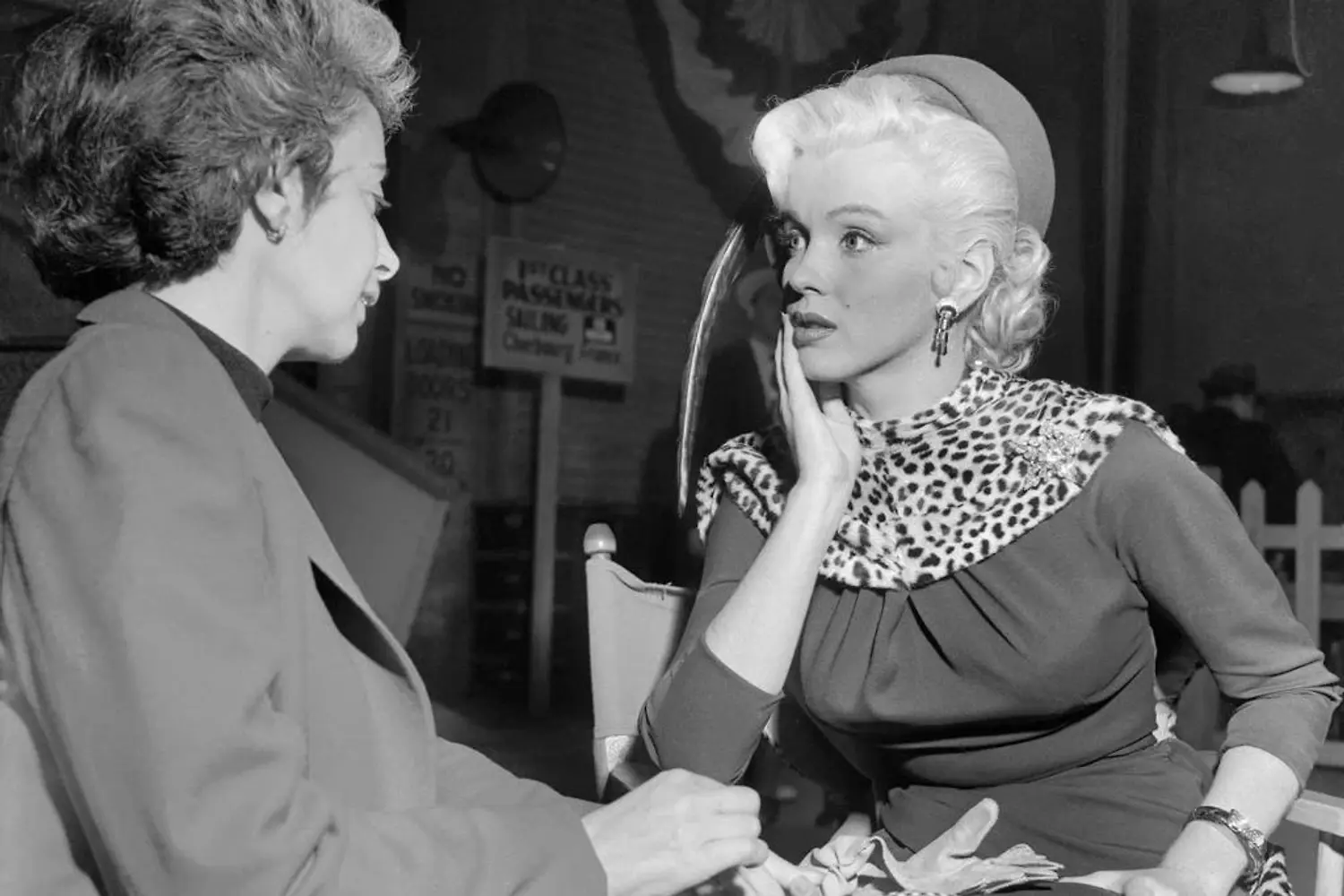 Marilyn Monroe in Cheetah print
 Julie Goodyear is a Leopard print coat
 Jennifer Saunders in a Cheetah print coat
We reach for certain things for a reason.
The leopard print, the loosened hair, the garment that signals we are not, tonight, the version of ourselves that behaves.
The choice is older and more specific than style.
We are standing in a lineage of women who dressed deliberately for transformation, who understood that what you put on your body is never merely what you put on your body.
When the Maenads reached for the fawn skin and the leopard pelt, they were performing a departure from the city… from the supervised and from the self that other people had decided they were.
Every time you get dressed to go somewhere you aren’t supposed to, so are you.