To tell this most British of stories, as is often the case, we have to start somewhere else entirely. We've already nicked our language, our menu and half our wardrobe from our neighbours, so why stop there?
Introducing the template for our national criminal... starting with a Frenchman.
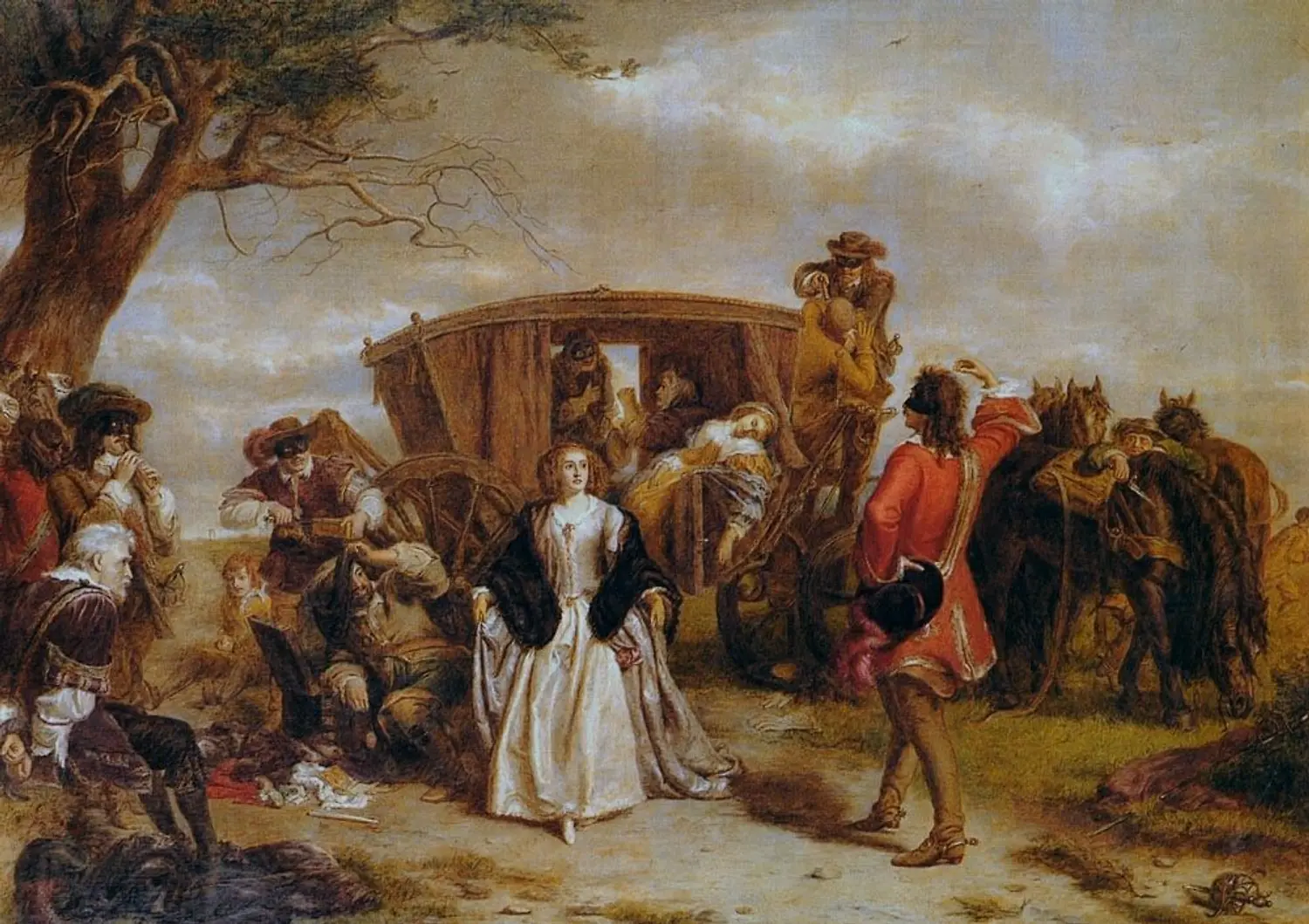 William Powell Frith Claude Duval painting Manchester Art Gallery
Somewhere in the late 1600s, Claude Duval stopped a coach on Hounslow Heath. He was twenty-six years young and unsuspectingly dressed to the nines. Duval had recently arrived at the conclusion that highway robbery suited him better than honest graft, and so far the evidence was on his side.
Inside the carriage, sat alongside a gentleman and his wife, was four hundred pounds in gold coin. For a bit of perspective, the melt value alone would land you somewhere around £300,000 today. The numismatic value? You're talking several million, comfortably.
Anyway, Duval jumped on to the carriage with his pistol in plain sight and asked, ever so politely, whether he might have the honour of a dance with the gentleman's wife. Having clocked what was holstered, the gentleman quickly agreed. The lady stepped down from the carriage, an accomplice produced music from somewhere (don't ask), and right there in the dust beside the stopped wheel, the two of them danced a coranto on the heath. When it ended, Duval returned the lady to her seat, gently reminded her husband that he hadn't yet paid for the music, accepted one hundred of the four hundred pounds, and waved them on their way.
He was hanged at Tyburn in January 1670. They laid his body out by candlelight at the Tangier Tavern in St Giles, where crowds turned up in their droves just for a look. Two hundred years later, William Powell Frith painted the dance entirely from imagination, and you can still go and see the result hanging today in Manchester Art Gallery.
Now look, the story might be true, most of it probably isn't and I think we can all agree on that. But here's the thing, the British criminal, at his most memorable, has always been painted as a bit of a performer. Yes, he steals, frightens, wounds and occasionally, he murders. Yet there remains an old tradition in our country whereby men taking things they were never supposed to have somehow ended up weirdly admired for it.
There's a successful version, who dresses for the part and conducts himself by an almost admirable code. He understands that the gap between him and the establishment might amount to no more than a desk or a job title. The establishment, naturally, calls this a line. Thin, blue, or otherwise, history suggests it was always a bit more flexible than that.
Now we'll mention the Krays briefly and then put them to one side, because they're the easy answer, and the easy answer is rarely the most interesting one. They earned their celebrity, milked it for everything it was worth and have since provided enough television drama to keep a few minor channels in business indefinitely. There are far more interesting men out there, less polished perhaps, who somehow managed to slip past the spotlight altogether.
Take Billy Hill, born 1911 in Seven Dials. To help with the housekeeping, his old mum used to fence stolen goods on the side. Apple, tree, you know how it goes. By the early 1950s, our Billy was running Soho. He'd refined the smash-and-grab into something that resembled industrial practice and added a few lorry hijackings to the rustling repertoire while he was at it. In 1952, he pulled off the Eastcastle Street postal van robbery, hauling a tidy £287,000, which works out to about seven million in today's money. Nobody was ever charged for it. Two years later, a bullion heist netted him a further £40,000. That one also went unsolved.
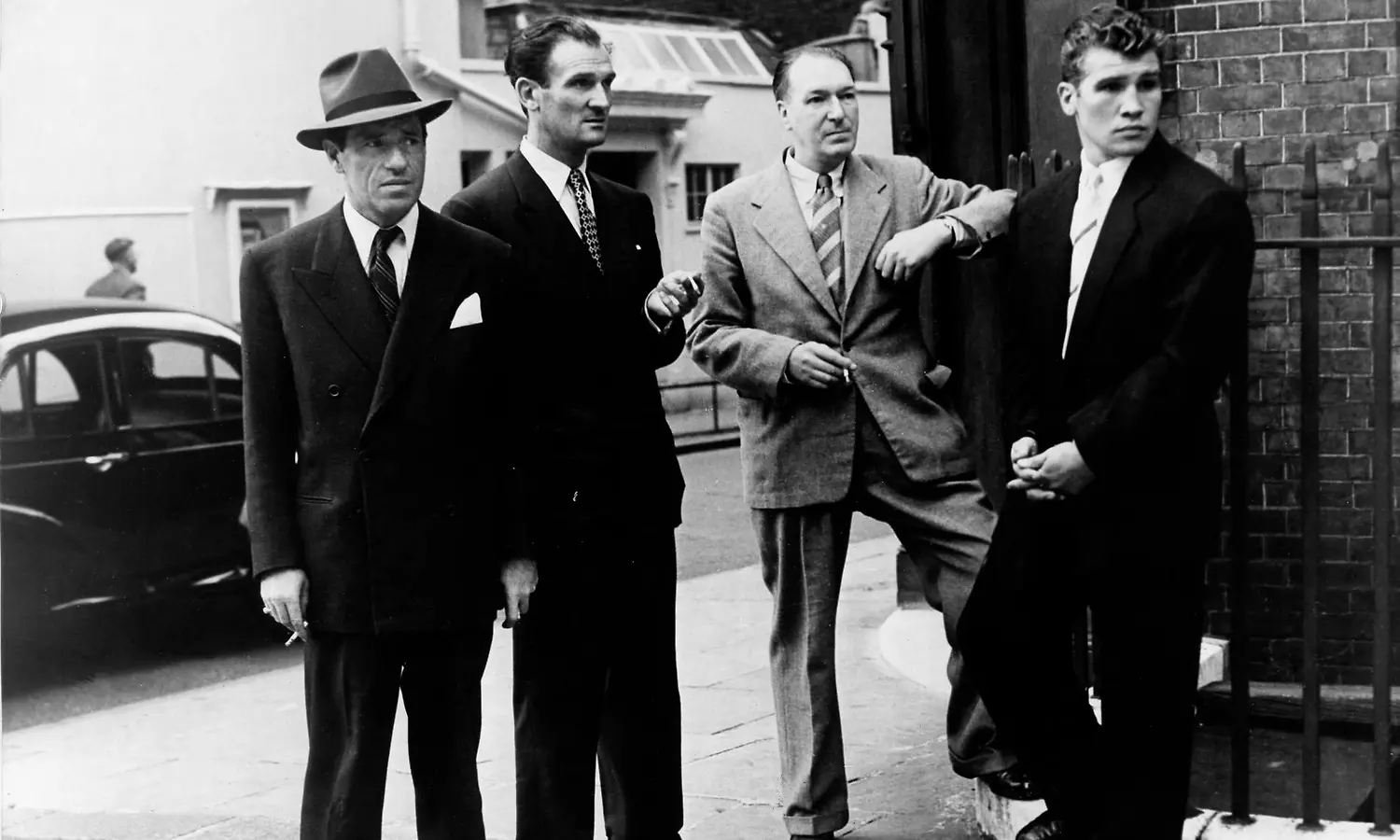 Gangster Billy Hill, left, with underworld figures in London in 1955.
In 1955, while still very much active, Hill published Boss of Britain's Underworld and (this is the bit I love) sold copies in his own clubs. The book described his preferred use of a blade with the calm of a man explaining a fishing knot. Drawn slowly down the face, never across or upwards. A slip in the wrong direction, you see, might cut an artery, and as Billy himself put it, while shivving was shivving, murder was for mugs.
The thing about Billy Hill, was that he understood the importance of reputation, and how to treat it like an asset. By most accounts he regarded the likes of the Krays as amateurs and rather than going out in a blaze of glory, he died quietly at home in 1984, wealthy, surrounded by family, on his own terms.
Now, Manchester played its part too around this period. Up in Ancoats and Collyhurst, you had a group of lads who became known as the QSG, or Quality Street Gang. The name was earned in a pub in the late 1960s, when one of the better-dressed members walked in to a heckle from an onlooker. "Here's the Quality Street Gang," he shouted, after the Mackintosh chocolate-tin advert with the smartly turned-out couple in evening wear. The name stuck.
These lads wore tailored suits from the best tailors in Manchester, drove Jaguars and held court at Deno's, a Deansgate club with a dress code famous for turning Mick Jagger away for looking too scruffy (one is tempted to call that public service).
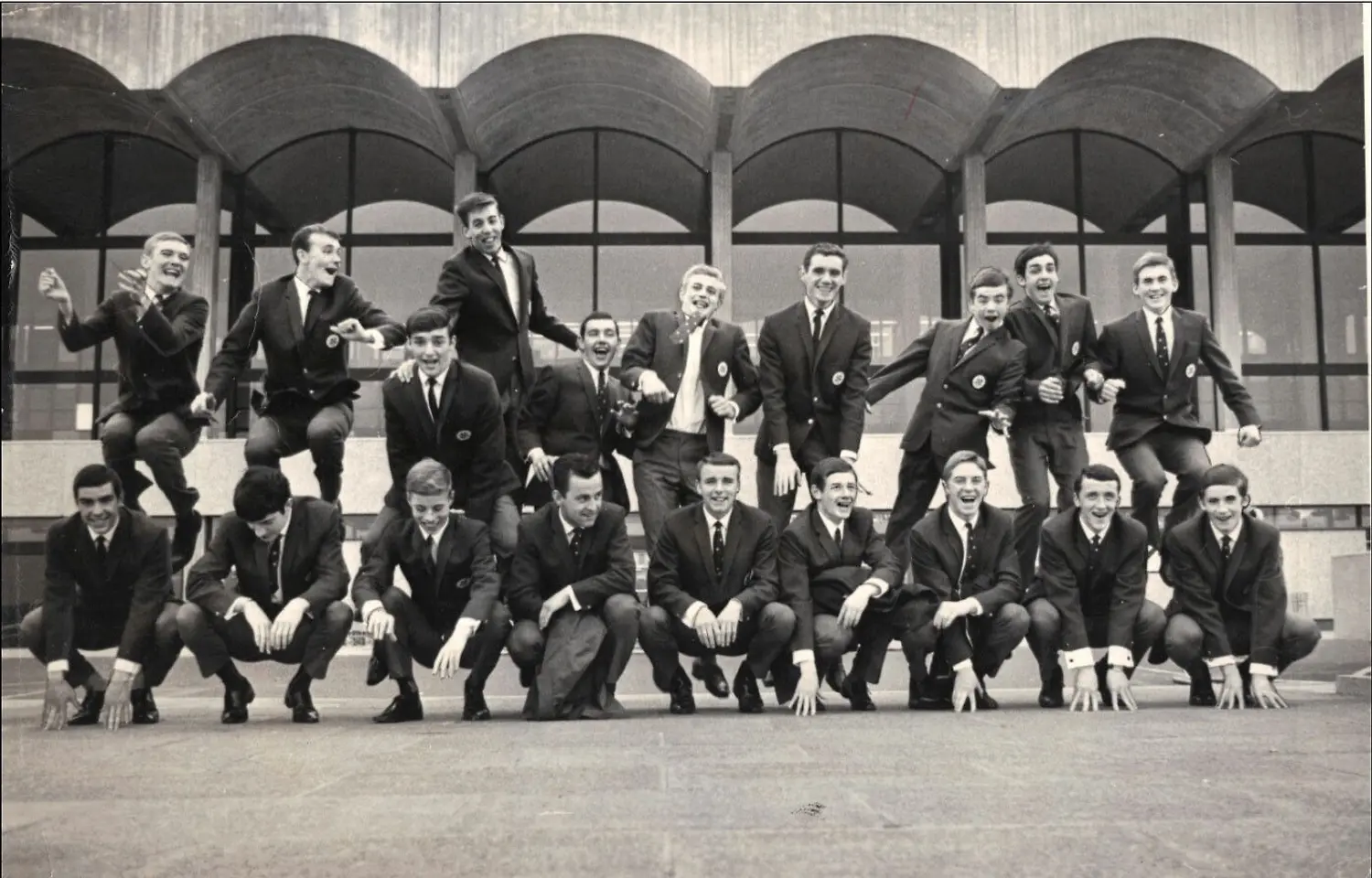 Quality Street Gang Manchester 1970s
As for what they actually got up to, well, it's still very much up for debate. Senior Greater Manchester Police officers later admitted that not a single member of the gang had ever been convicted of a single crime in the two decades they were supposedly active. Some reckoned they were nothing more than a tight-knit group of expensively dressed lads who happened to drink in the same places. Others, including deputy chief constable John Stalker, clearly thought otherwise. Although Stalker himself was suspended in 1986 over allegations of having attended social events at which gang members were also present. Perhaps an awkward overlap when a city only has so many decent restaurants. Perhaps not.
Remember Thin Lizzy's The Boys Are Back in Town? Yep, you guessed it. Written about the QSG. Phil Lynott's mum ran the Clifton Grange Hotel in Whalley Range, where the "boys" used to drink with the likes of George Best, Helen Shapiro and a fair few other Manchester celebrities of the day. And yet, somehow, they still existed more as rumour than anything you could pin down.
Every British city has its version of this story. But our next stop takes us back down to London, where Charlie and Eddie Richardson were, by all accounts, the genuine article. Scrap dealers from Camberwell, their reputation was built on torture. At their 1967 Old Bailey trial, descriptions emerged involving pliers, bolt cutters, car batteries, electric generators, teeth and toes. The press dubbed them the Torture Gang. Their infamous enforcer, Frankie Fraser, racked up forty-two years of prison time over the course of his career and acquired the nickname "the Dentist". No further explanation required.
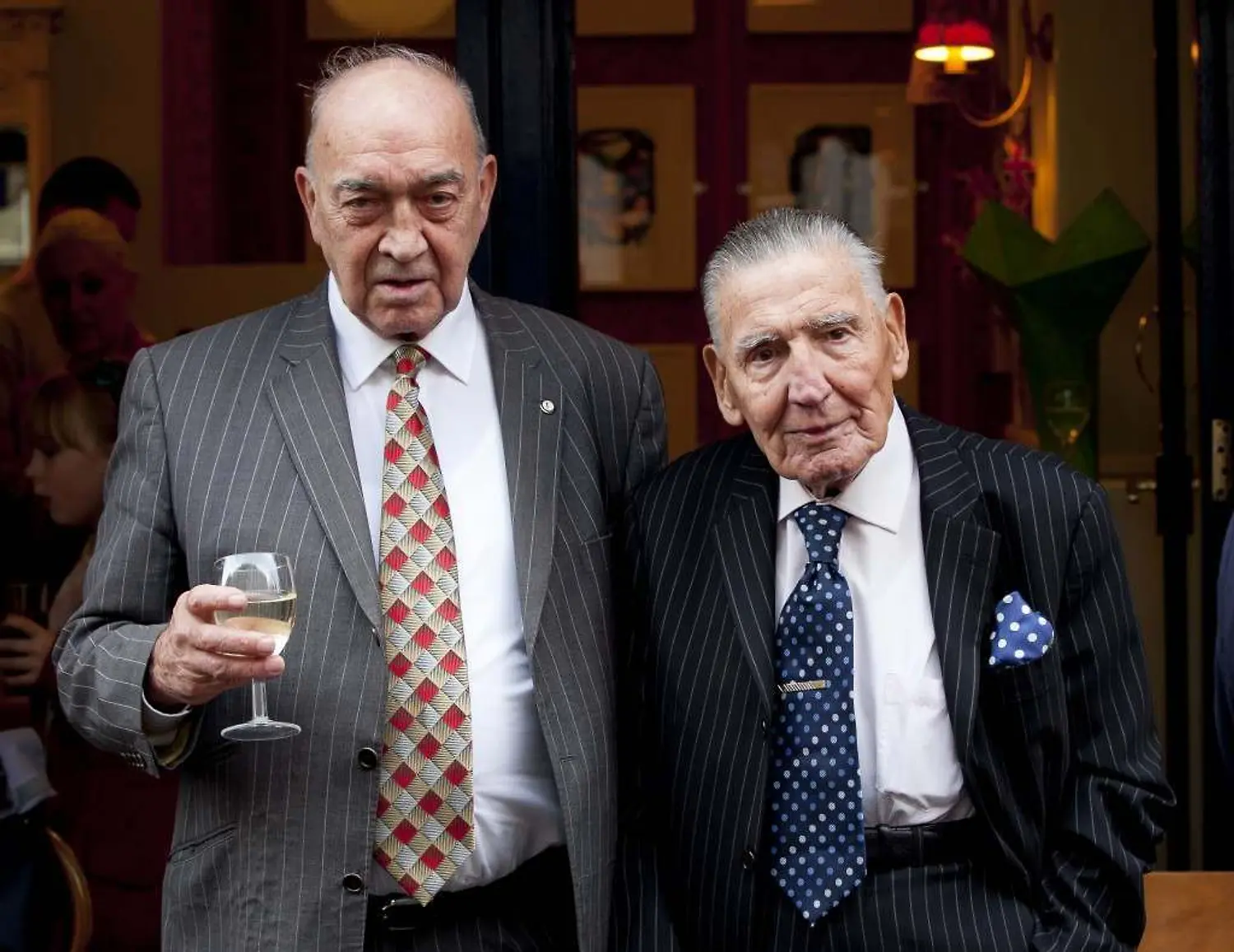 Eddie Richardson and Frankie Fraser
Now, as nasty as the Richardsons' methods were, it's their connections that make them properly fascinating.
Charlie owned a stake in a perlite mining operation out in the Transvaal. At some point in the mid-sixties, he was either approached by, or approached, the South African Bureau of State Security, the apartheid regime's intelligence service known as BOSS. By Charlie's own later admission, the plan was to tap the telephone of the then Prime Minister, Harold Wilson. Whether the operation actually went anywhere is anyone's guess. Charlie was the kind of bloke who tailored a story to whoever was buying lunch. What we do know, on the record, is that he was considered useful enough by a foreign intelligence service to be part of the conversation in the first place.
Several of the witnesses at the Richardsons' trial, having been granted immunity, were issued with new identities and passports by the Home Office and relocated to Spain and Mallorca. Some stayed there for life. The Costa del Crime, as it came to be known, was largely furnished by the British state.
A south London scrap dealer with a sideline in apartheid wiretapping. This was never just a London underworld story. It was always wider, stranger, and a good deal closer to official life than the official version cared to admit. Robert Boothby would go on to prove the point.
Lord Boothby was a Conservative peer, an Eton and Oxford man, a former private secretary to Winston Churchill and one of the most popular broadcasters of his generation. He'd also been carrying on a thirty-year affair with Lady Dorothy Macmillan, wife of the man who would later become Prime Minister. We all know the world's a small place. Apparently, no less so within the British establishment.
By 1964, Boothby was involved with Ronnie Kray. Kray's interest in him was practical, of course. Boothby had social access, and Boothby had appetites Kray could service. There were photographs, there were witnesses and In July 1964, the Sunday Mirror put a story about a peer and a gangster on its front page.
Then the wheels started turning. Arnold Goodman would Max Clifford himself on Boothby's behalf, prompting the Mirror to retract the story and pay Boothby £40,000 in damages (more than £900,000 in today's money). Editors who had pursued the story were quietly sidelined. Tom Driberg, a Labour MP also entangled with the Krays, was protected by his own party for much the same reason the Tories were protecting Boothby. Both sides had skin in the game. Neither side wanted the public's curiosity getting any further. So despite MI5 and the Metropolitan Police holding all the files, nothing ever quite surfaced.
The Krays carried on operating openly in London for another four years, killing at least two men in the process, before they were finally brought down by Nipper Read, a detective who somehow had the rare advantage of not owing anyone a favour. Then, in 2015, the MI5 files were declassified and predictably confirmed the whole arrangement. Boothby had been a national institution, a procurer's client, a blackmail risk, and as if all that wasn't enough, a Cold War intelligence concern.
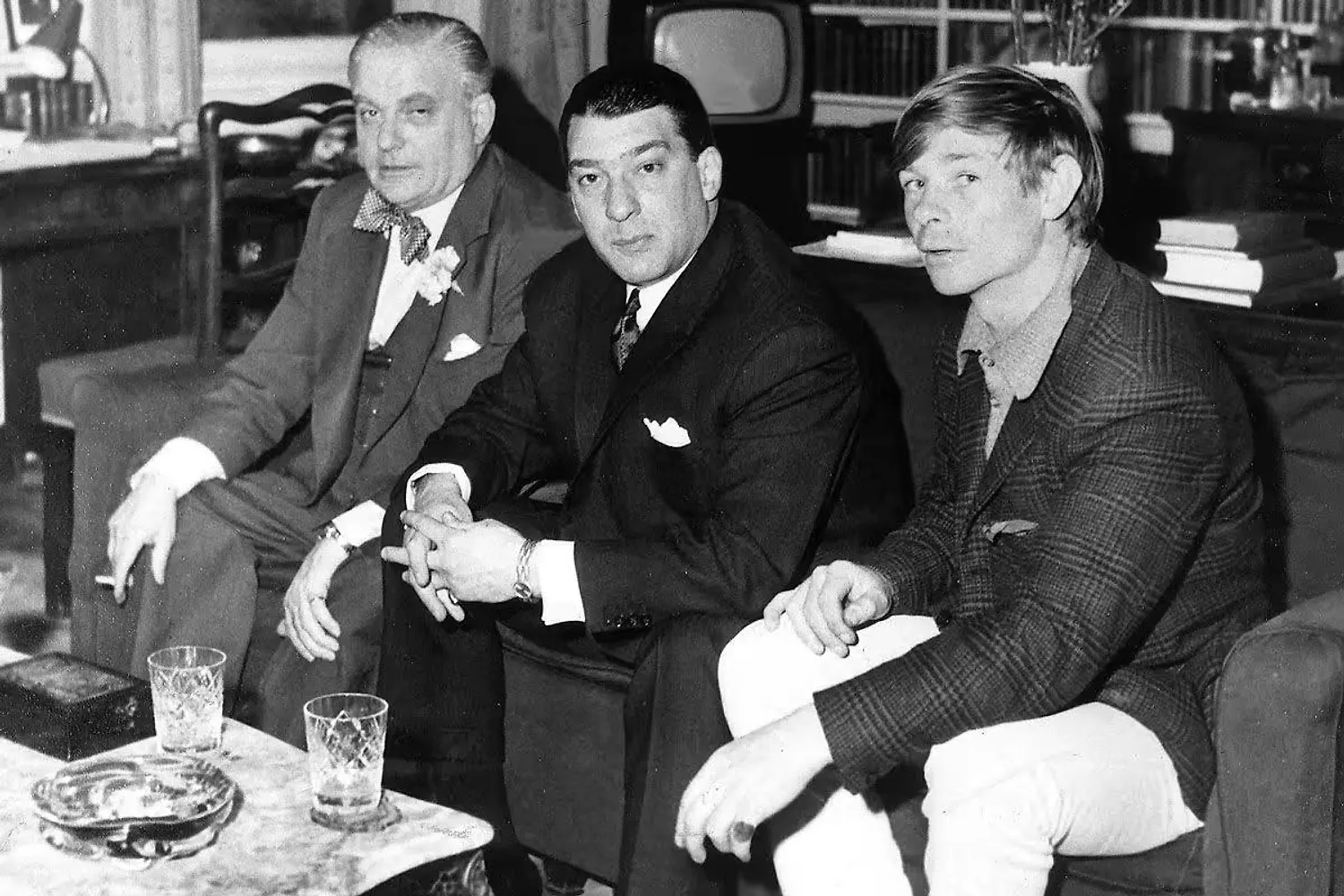 Ronnie Kray with Lord Boothby and Leslie Holt
Right, moving on. In September 1971, a gang led by a London photographer called Anthony Gavin tunnelled forty feet underground from a leather goods shop on Baker Street, straight into the vault of Lloyds Bank two doors down. The plan, brilliantly, was lifted almost word for word from The Red-Headed League, the Sherlock Holmes story in which criminals tunnel into a bank vault from a nearby cellar.
The crew set up at weekends and would dig only when the road outside was being resurfaced loudly enough to mask the noise. On the 11th of September, they got into the vault.
Now here's the bit you couldn't make up. One of the perks of the comparatively rudimentary technology of the day was that a radio enthusiast called Robert Rowlands picked up their walkie-talkie chatter on his amateur set in Wimpole Street and immediately rang the police. It still took officers more than twelve hours to find the right bank, by which time the gang had long since gone. They walked off with an estimated three million pounds from the safety deposit boxes. Four men were eventually arrested, but most of the money was never recovered.
For some reason, within four days of those arrests, all press coverage suddenly ceased. A D-Notice (a formal government request for media silence on national security grounds) had been issued. The reason has never officially been clarified, but the rumour that still persists to this day is that one of those boxes contained photographs of Princess Margaret in compromising circumstances on Mustique with the actor and convicted criminal John Bindon. The papers relating to the robbery remain sealed in the National Archives until January 2071. We'll know in forty-six years. Assuming the files haven't developed a sudden and regrettable damp problem.
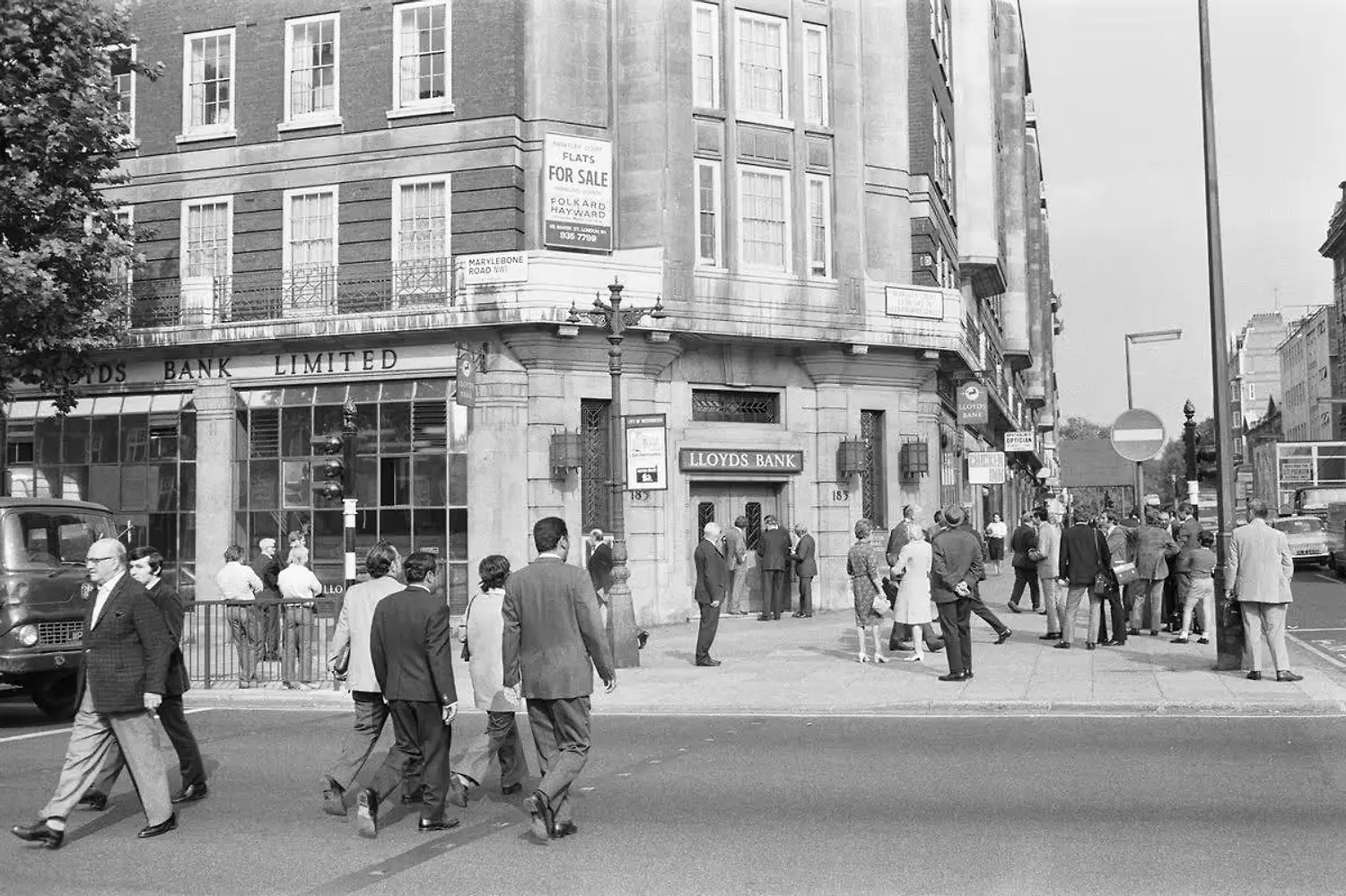 Lloyds Bank on Baker Street on September 11, 1971
In 1983, six men in balaclavas walked into a Brink's-Mat warehouse near Heathrow expecting cash and got the surprise of their lives when they found three tonnes of gold bullion worth twenty-six million pounds. Undeterred, the crew passed the haul to Kenneth Noye, who smelted it down in his garden in Kent, mixed it with copper to disguise its origin, and laundered the result through John Palmer's gold-dealing operation in Bristol. Noye killed an undercover police officer in his garden in 1985 and, somehow, was acquitted on grounds of self-defence.
The proceeds moved into property. Docklands developments. Pubs in Kent. Timeshare empires in Tenerife. The BBC later reported that anyone who'd bought gold jewellery in Britain after 1984 was statistically likely to be wearing some of Brink's-Mat. Wedding rings up and down the country, doing time on someone else's behalf.
Many of the robbers died violently. Brian Perry was shot dead in 2001. Donald Urquhart was shot dead on Marylebone High Street in 1993. Solly Nahome was shot dead outside his home in 1998. The money, by contrast, had rather better survival instincts.
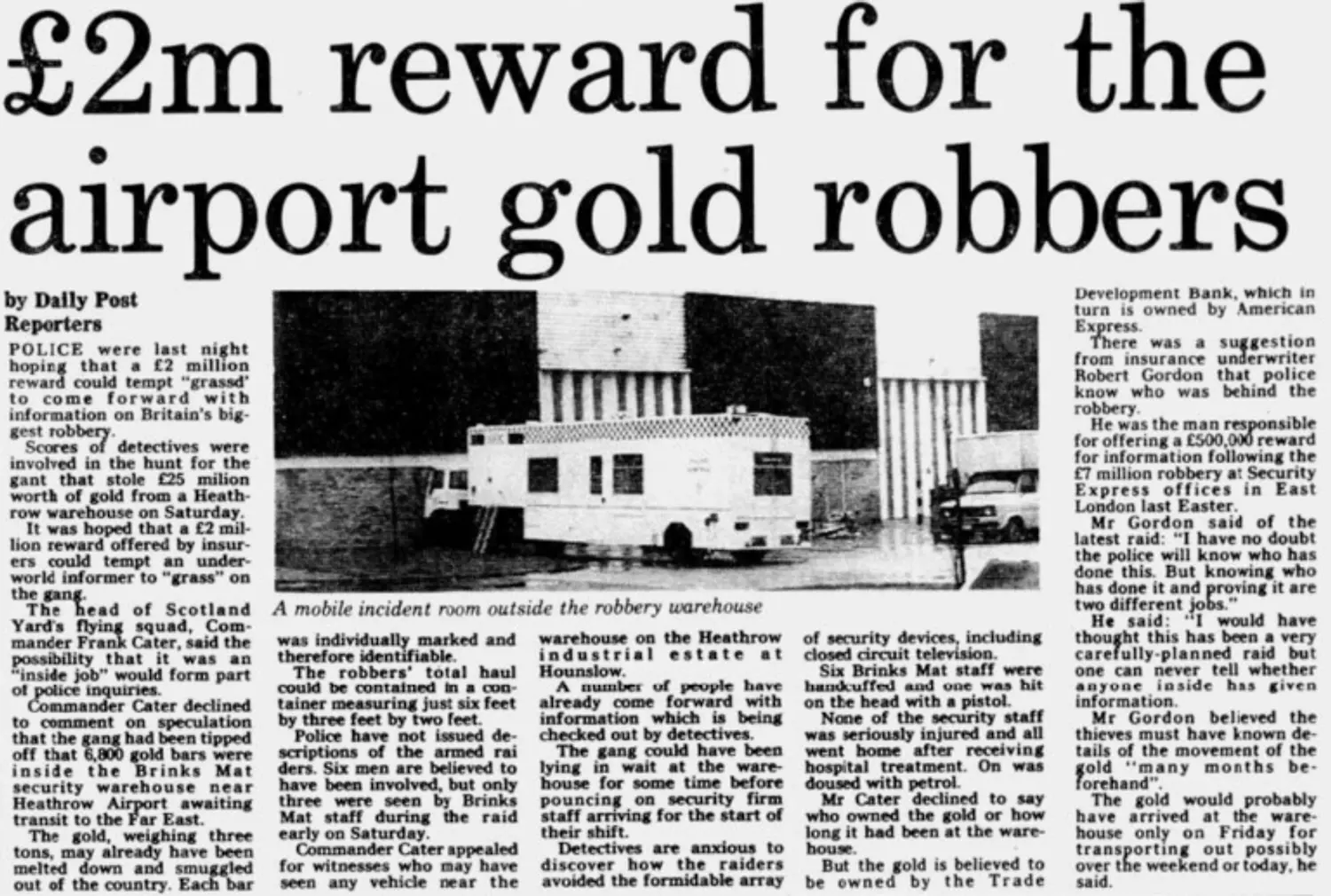 Liverpool Daily Post | 28 November 1983
Then, came Hatton Garden.
In 2015, after three years of careful planning, a crew of men with a combined age of 278 drilled through fifty centimetres of reinforced concrete and into the Hatton Garden Safe Deposit vault over the Easter bank holiday weekend. Brian Reader was seventy-six. Terry Perkins was sixty-seven. Daniel Jones was sixty. Kenny Collins was seventy-five.
Brian Reader was the ringleader, and he'd been on the edge of Brink's-Mat thirty-two years earlier. He'd also been at Noye's house on the night the undercover officer was killed and was acquitted of murder alongside him. As an aside, for this particular job, it's understood that Reader travelled to the heist from Dartford on the number 96 bus, using the Freedom Pass given to London pensioners. One can only wonder whether the irony struck him at the time.
They were caught in the end, of course. Kenny Collins fell asleep during his lookout shift. Terry Perkins was recorded on a bugged car calling the job "the last fling". And police found a copy of Forensics for Dummies at Daniel Jones's house. Of all the things their budget afforded them, professional-standard counter-surveillance literature appears to have been beyond them. During the investigation, the senior officer described the crew as "analogue criminals operating in a digital age". Shortly after sentencing, Brian Reader suffered a stroke and was released on compassionate grounds but still owes £6.6 million in confiscation orders.
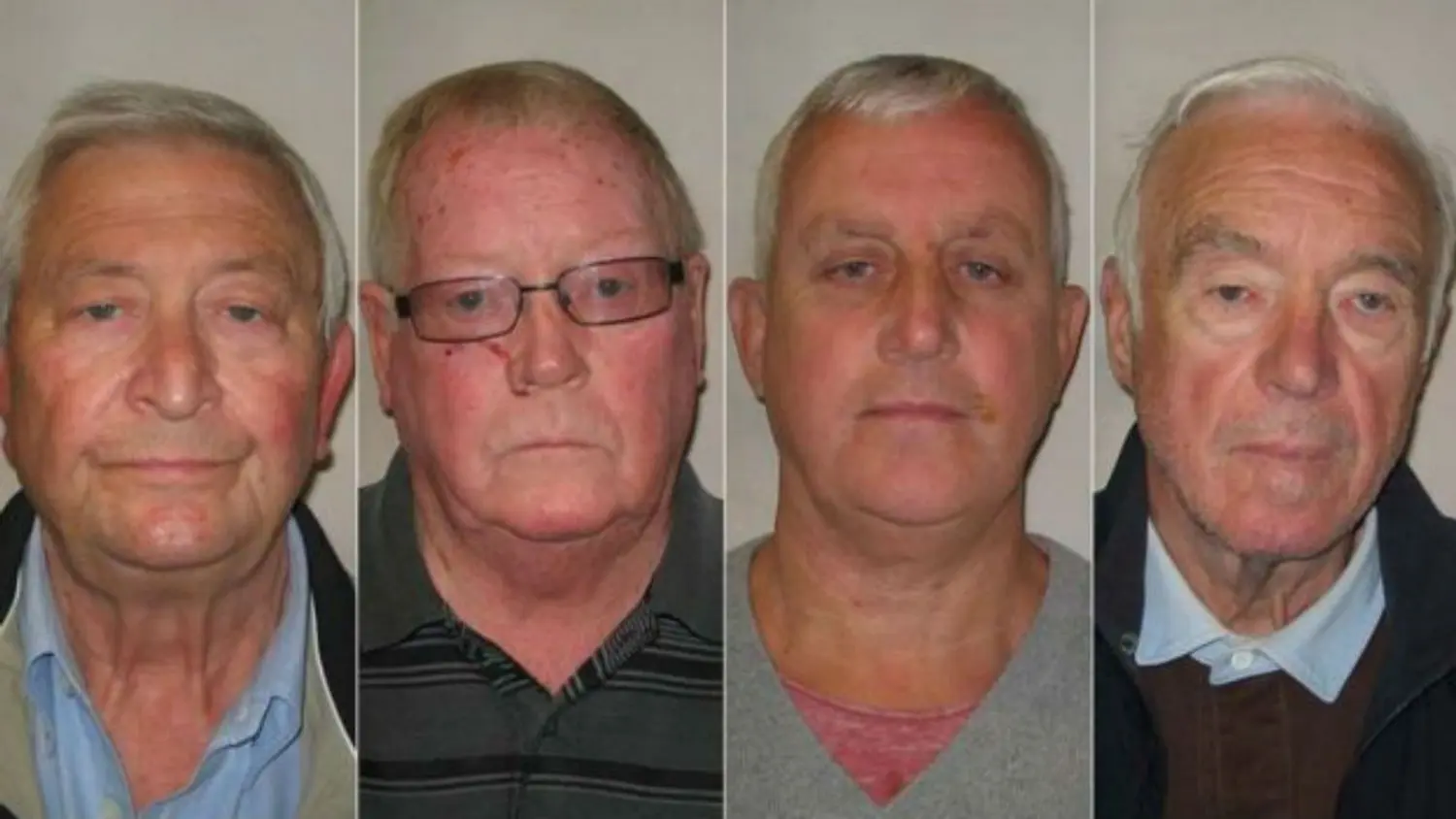 L to R - Terry Perkins, John Collins, Daniel Jones, Brian Reader
In the past three decades alone, the British gangster has been given more screen time than at any point in our history. Lock, Stock and Two Smoking Barrels in 1998 turned Guy Ritchie into a household name and made cockney slang the second language of every sixth-form common room in the country. Peaky Blinders, ostensibly about a Birmingham razor gang in the 1920s, ran for six seasons and filtered all the way through to barber shops nationwide.
From Hounslow Heath to Hatton Garden, whether we like to admit it or not, there's a particular type of Englishman who mixes charm with brutality in a way that somehow keeps him one step ahead of the authorities. Or is it the other way round?
He's the chicken and the Fabergé egg. Holding both, smiling for the camera.