This is our look at British comedy and the grotesque, from Hogarth, Gillray and Cruikshank to Spitting Image, Viz, Beryl Cook, Scarfolk and The League of Gentlemen, and why Britain’s funniest traditions are often its most badly behaved.
Of the many ways one might describe British Comedy, “dry” is usually the word that gets wheeled out first. I suppose that’s pretty fair. I mean, we have achieved quite a lot with nothing more than a raised eyebrow. It’s part of our national identity to say absolutely nothing and mean three things at once. But, as is often the case, there are two sides to every story, and then there’s the truth.
At the core of the Great British comical caricature is a damper, more swollen, slightly rotten reality. One that peers out from the dark with one eye larger than the other, poised to assassinate anything that vaguely resembles authority.
This is not to dismiss the dry. As an island, quite frankly, we need all we can get. We will always adore the dramatic pause, the sideways glance and the joke buried so deep in polite pleasantry that specialist equipment is needed to uncover it.
But there is another face to British Comedy. One sporting a terrible set of teeth and a fondness for making politicians look like root vegetables. It makes pleasure vulgar, respectability faintly horrifying and local life deeply strange.
And if we’re honest with ourselves, it probably gets closer to the truth than many more polished forms of media ever could.
“Many a true word hath been spoken in jest”
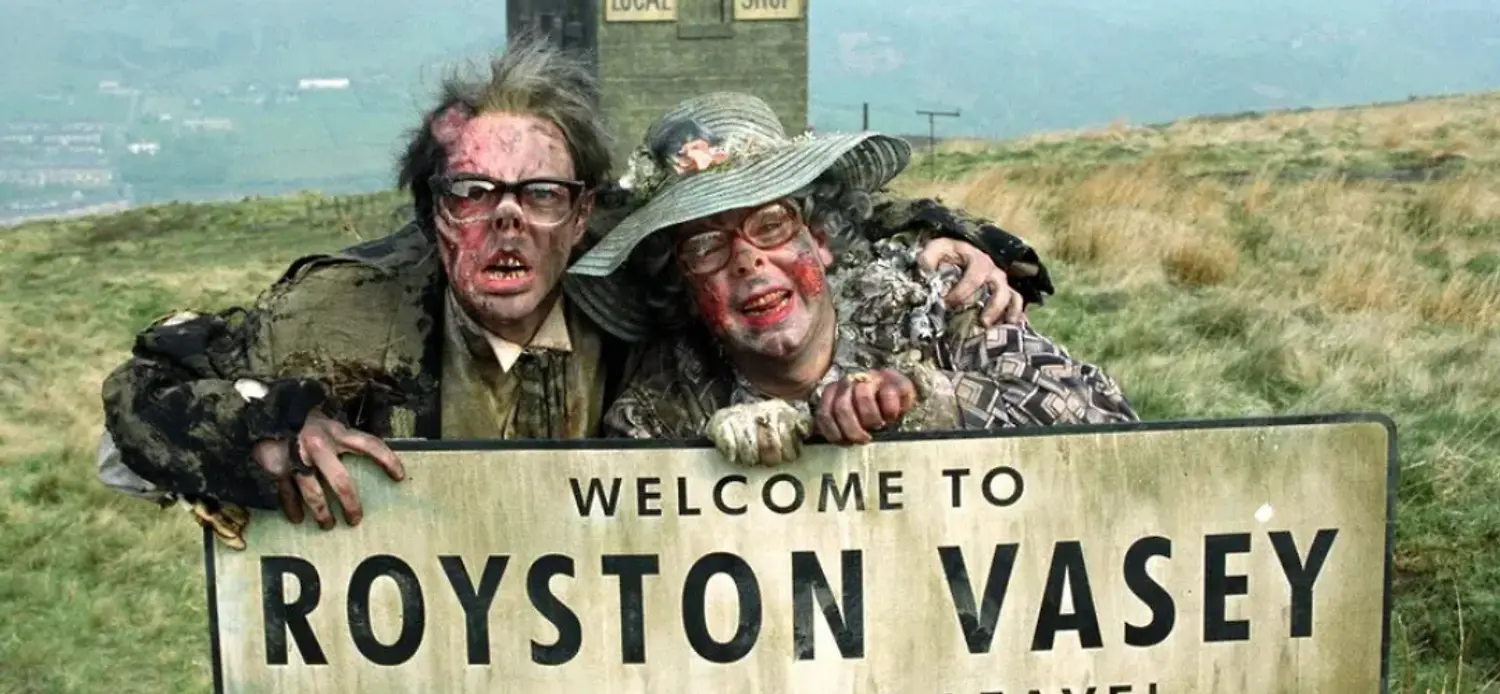 Local Shop Owners, Tubbs and Edward
The Other Face of British Comedy
When you actually dissect British Comedy, it’s actually a bit of a humble brag, don’t you think? Oh, aren’t we ever so understated and restrained with our ironic quips signalling our superior intellect and our self-deprecation that is definitely not some kind of pseudo-narcissistic veiled attempt at modesty. Aren’t we clever and aloof, unbothered and far too well brought up to make a scene… well in truth, no we are not.
We are deeply depraved, devilishly devious and beneath that well-mannered visage lies an appetite for cruelty. We are not modest, we do not leave things unsaid and we cut closer to the bone than almost any nation.
British Comedy has its Dr Jekyll, certainly. Absolutely clean as a whistle. But we’re here for Mr Hyde, and the strange cast who brought him to life.
 Fredric March as Mr Hyde, with Miriam Hopkins, 1931.
Hogarth, Gillray and Cruikshank: The Foundations of Satirical British Comedy
We begin our story in the 1730s and 40s with William Hogarth, who painted a series of underbelly-esque scenes such as A Rake’s Progress and Marriage A-la-Mode. Overcrowded, disreputable depictions of modern life, from gambling dens and brothels to fashionable marriages putrefying from the inside out. Gouty drunkards all heading for ruin.
 William Hogarth - A Rakes Progress, Tavern Scene
Take Gin Lane, which, to this day, remains one of the most efficient pieces of public health messaging ever produced. A city drinking itself to death, surrounded by anarchy but anchored by the horrifying central figure of a mother too far gone to notice her own baby falling from her arms.
Moral panic and social criticism combine to present the entire idea of the British grotesque on one subtly terrifying plate.
James Gillray arrived with a slightly sharper edge. He took the leading men of the era and turned them into something far more physically unappealing. In 1805, he drew The Plumb-pudding in Danger, featuring British Prime Minister William Pitt and French Emperor Napoleon Bonaparte carving up a globe-shaped pudding between them. Imperial greed, served as dessert.
 James Gillray - The Plumb Pudding in Danger, 1805
George Cruikshank then pushed the whole thing further into popular print. He was enormously prolific, illustrating Charles Dickens’ second novel, Oliver Twist, among a great deal more.
Between the three of them, a cultural grammar was established and the establishment was the enemy.
 Oliver Twist by George Cruikshank, 1837
Scarfe and Steadman: The High Executioners
If Hogarth put British power in the dock, Gillray read the charges and Cruikshank brought down the hammer, Gerald Scarfe and Ralph Steadman took it straight to the block and lopped off its head.
Both born in 1936, they came up together, having met at the Cartoonists’ Club before going on to study alongside one another. Their styles sat close enough for overlap to become almost inevitable, and when their careers began to gain traction, friendship gave way to rivalry. Scarfe’s commercial career took off, leaving Steadman feeling overshadowed and causing him to veer, as he put it, into more esoteric work. The pair fell out and stayed that way.
In terms of style, Scarfe was known to shoot for the jugular. From his time with Private Eye in the 1960s to the subsequent decades he spent with the Sunday Times, he built a reputation for drawing public figures as unflattering arrangements of jowls and rotting teeth. His 1963 image of Harold Macmillan posed nude in the manner of Christine Keeler famously got an entire annual banned, and his drawing of Nixon wiping himself with the American flag really needs no further explanation. Then there’s the sharp-beaked image of Margaret Thatcher, part battleaxe, part blind automaton.
 Margaret Thatcher as Britannia: ‘The Sun Goes Down’
Steadman, on the other hand, went somewhere stranger. His inked splats and blots feel furious. Where Scarfe made portraits, Steadman created visceral atmospheres that felt paranoid, disdained and disgusted. Most famously, he teamed up with Hunter S. Thompson and illustrated a style of derangement that seemed to leak off the page and together, they helped define Gonzo art and journalism.
 Ralph Steadman with Hunter S. Thompson
 Fear and Loathing in Las Vegas, Ralph Steadman, 1971
Spitting Image: Rubberising the Establishment
One of the most recognisable modern examples of the grotesque is Spitting Image, which first aired on ITV in February 1984 and ran until 1996, pulling in audiences of more than 15 million at its height.
We have Peter Fluck and Roger Law to thank for it. Styling themselves as “Luck and Flaw”, they had been making three-dimensional plasticine caricatures for the Sunday Times before, with the help of designer Martin Lambie-Nairn, turning the whole grisly business into a television series.
The puppets will go down in history alongside some of Jim Henson’s great creations. My personal favourites include, Margaret Thatcher as a suited bully who would use the gents’. John Major in grey and of course, The Royal Family. Rendered with an unfamiliar cruelty, this was the first time we would see our Monarch regarded with anything but the utmost reverence.
This was the beauty of Spitting Image. Cartoons and comedians have always been able to get closer to the truth than any argument ever could. As one of the show’s actors put it, this was a naughty programme for children who stayed up too late. But for a lot of young people, it was also the first time politicians had names, faces and identifiable defects. It stripped dignity from public life by making power look vulgar and unstable which, in fairness, was not always much of a leap.
 Margaret Thatcher and John Major, Spitting Image
Viz: Page Three of the British Mind
Born in a Newcastle bedroom in 1979, Viz was put together by Chris Donald with his brother Simon and schoolfriend Jim Brownlow. The first issue ran to around 150 photocopies, cost a little over £40 to produce, and was sold at local punk gigs for 20p a piece. Let me help you with the maths… yes, it made a loss, but it still sold out and in doing so, set the scene for a multi-generational, published toilet wall that still has its middle finger pointed northwards to this day.
Its form was a straight hijacking of the post-war British children's comic, borrowing the visual language of The Beano and The Dandy with their bold outlines, simple panels and seemingly innocent little faces. Into that familiar format, Viz poured almost everything considered uncouth, from swearing and bodily functions to sex, drink, bad families and male uselessness.
Notable characters include Sid the Sexist, a Geordie whose entire personality centred on his failure to talk to women. Roger Mellie, the foul-mouthed, obnoxious television presenter whose misogyny knew no bounds. Biffa Bacon, trapped in a family whose main form of communication appeared to be violent antics aimed at his groin and perhaps most famously, The Fat Slags.
At this point, we should say plainly that a lot of these characters need handling with care. Some of it has definitely aged into genuine unpleasantness. Some of it was crude and most of it appears to have been designed with a quite deliberate nastiness. But we are not here to acquit the comic. The point is that Viz did not lower British culture so much as reveal a level of depravity that had always been there, by taking playground insults, pub jokes and dirty postcards and giving them nationwide distribution.
 Fat Slags: Viz No.36 June 1989
Beryl Cook: Lippy, Lager and Larger Measures
So far, we have leaned into the crueller side of grotesque British comedy. But there is a far more affectionate version, drawn by Beryl Cook.
Born in 1926, Cook was self-taught and, crucially, a late starter. She was in her late thirties when she finally picked up a paintbrush, and her first exhibition didn’t land until 1975, at Plymouth Arts Centre. By then, Plymouth had already become her great subject. She famously painted the local pub, club and dancefloor scenes, and she painted them in full.
The people she painted were equally full, squozen into their best attire, sporting flushed cheeks and raised glasses. The bodies are famously exaggerated to comic proportions, but this is celebration, not attack. There is no punishment in Cook’s work and no moral lecture. There’s a warmth, a joy you can almost feel emanating from each piece. A jolly good time being had by people who were often painted, when they were painted at all, as a problem.
This was actually quite radical at the time. British comedy has long had a habit of poking fun at the working class. Cook made them the centre of attention and presented them proudly, in all their magnificence, larger than life and all the better for it.
 Birthday Surprise by Beryl Cook, 1989
Scarfolk: Where Public Safety Goes to Die
A fictional town in the north-west of England, Scarfolk is the invention of writer and graphic designer Richard Littler. Launched in 2013 and drawn from his own 1970s childhood, Littler presents fake ephemera such as public information posters, council pamphlets and product packaging, all rendered in the familiar pastel bombast of the real thing.
A leaflet warns that “people are dangerous” and advises you to report anyone you know to the authorities. A pair of “Only See What You Want To See” goggles turns denial into a government-backed leisure activity. Dystopian and absurd, whilst also feeling quite familiar and, dare I say it, inevitable.
Scarfolk must feel especially sinister to anyone who grew up on genuine 1970s British public information films of drowning children, hooded figures by dark water, electrical hazards and cheerful diagrams of everyday death. You recognise the register almost instantly because the design language emulates those reassuring fonts and municipal colour schemes we are so used to seeing.
Littler nudges things just slightly, creating a more bureaucratic edge to the grotesque. One that leaves you feeling like the council knows something we don’t and whatever it is, it’s terrible.
 A poster from a Scarfolk Council anti-people campaign.
The League of Gentlemen: Horror Hidden Behind Net Curtains
The League of Gentlemen arrived on the BBC in 1999, set in Royston Vasey, another fictional northern town with a famously dim view of outsiders. The work of Mark Gatiss, Steve Pemberton, Reece Shearsmith and Jeremy Dyson, it showed the darker side of provincial Britain through some of the most quoted characters in British comedy.
Take Tubbs and Edward of the Local Shop, two inbred shopkeepers who greet any stranger with the panicked, murderous refrain that this is a local shop for local people and there is nothing for them there.
In many ways, TLoG might be one of the most grotesque examples of all, not only in how it looks, but in how closely it seems to capture reality. There’s an odd, menacing undertone when you walk into a small British town unannounced. The room sizes you up instantly, then dismisses you before you’ve even had the chance to introduce yourself. The only difference is that in Royston Vasey, this sort of thing is a little less socially awkward and a little more missing persons report.
The show is populated as you would expect, with the doctor, vicar and shopkeeper, an am-dram society and a lone, extremely local taxi driver. All the same, safe soft furnishings of typical provincial life, but with a small twist that somehow makes everything feel absolutely appalling.
Politeness curdles into threat in the same way it does with Scarfolk’s council leaflet. It takes the settled, respectable surface of British life and peels back the net curtain, revealing what lies rotting beneath.
 LtR Jeremy Dyson, Mark Gatiss, Reece Shearsmith and Steve Pemberton
Why the Grotesque Matters
Pull these examples together and the grotesque starts to feel like a national pressure valve, puncturing authority. It exposes class anxiety and gives hypocrisy a physical form. We need the grotesque, to help keep things balanced, because a world made up of nothing but polish, would be as unbearable as it would be unbelievable.
In warts we trust.