Have a look at the top of this page, perched above the words British and Attire there’s a bird with its wings out. It’s the little icon in your browser tab, it’s our profile picture on Instagram and Facebook, and it’s at the top of every email we send you. We’ve never stopped to explain it, which, for a brand that bangs on about the details most people never see, is a bit of an oversight on our part.
The bird in question, is the magnificent red kite. Milvus milvus if you want the Latin, barcud coch if you happen to be in mid Wales. Having now read far more about it than is strictly healthy, I can confirm it is by far the most Brit-ish bird we could possibly have ended up with.
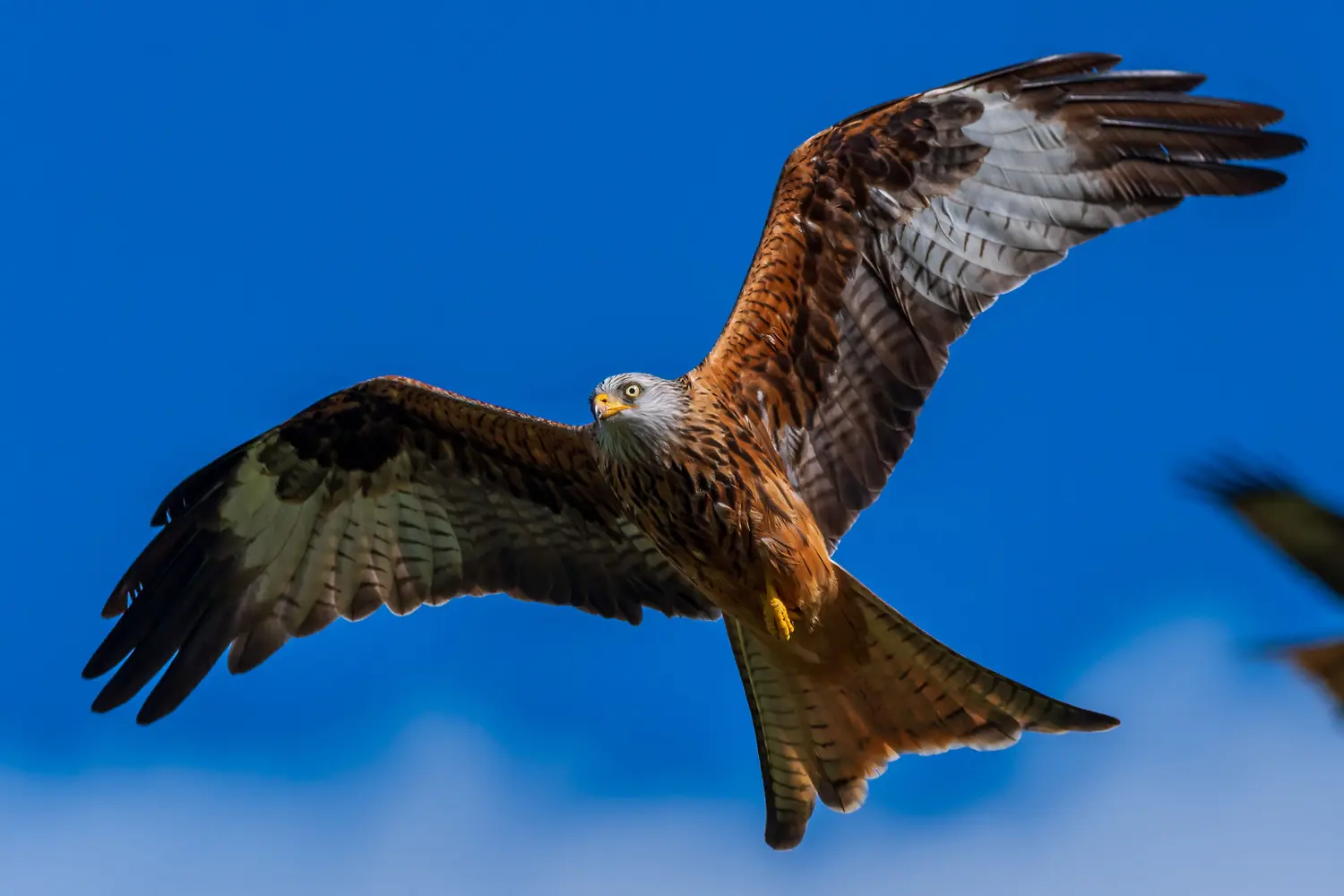 A Red Kite in Flight
A quick word about the name first
British Attire has never meant that everything we sell was made in Britain. Plenty of it was, and we’ll happily talk your ear off about a pair of Tricker’s or a Barbour that’s been rewaxed more times than its owner can remember. But you’ll also find Swedish jackets, Icelandic outerwear, Japanese outdoor gear, French wellies and American work boots on our shelves, and we’re every bit as proud of those.
As we tried to explain in Brit-ish Greats (the one where we ruined Percy Pigs for everybody), British Attire for us is a lens we look through when deciding what’s good enough to sit next to our name, and that eye has always had a habit of wandering abroad, finding the best of something and bringing it home. Fish and chips, the duffle coat, Dr. Martens, the English language… the list goes on.
So it’s rather fitting that when you dig into the history of the bird on our logo, you find a native British species that was hunted out of England and Scotland, kept alive in a handful of Welsh valleys, and eventually flown back in from Sweden and Spain.
London’s bin men
For a few hundred years, red kites were a fixture of British towns and cities, and nowhere more so than our capital city, London. Long before anyone dreamt up the council bin collection, the streets were full of rotting food, carrion and whatever else ended up in the gutter, and kites (along with ravens) did a lot of the clearing up. A traveller from Bohemia called Wenzel Schaseck visited in 1466 and reported that harming one in the city was a capital offence, which just so happened to be a considerable amount more protection than most Londoners could expect at the time.
Shakespeare clearly had them on his radar, and in King Lear, Lear himself calls his daughter Goneril a “detested kite”, which tells you the bird’s reputation wasn’t exactly spotless. To add insult to injury, The Winter’s Tale gives us “when the kite builds, look to lesser linen”, a warning about the kite’s habit of swooping on washing lines in nesting season and making off with your smalls to furnish the nest.
Now hold that thought, we’ll be coming back to it.
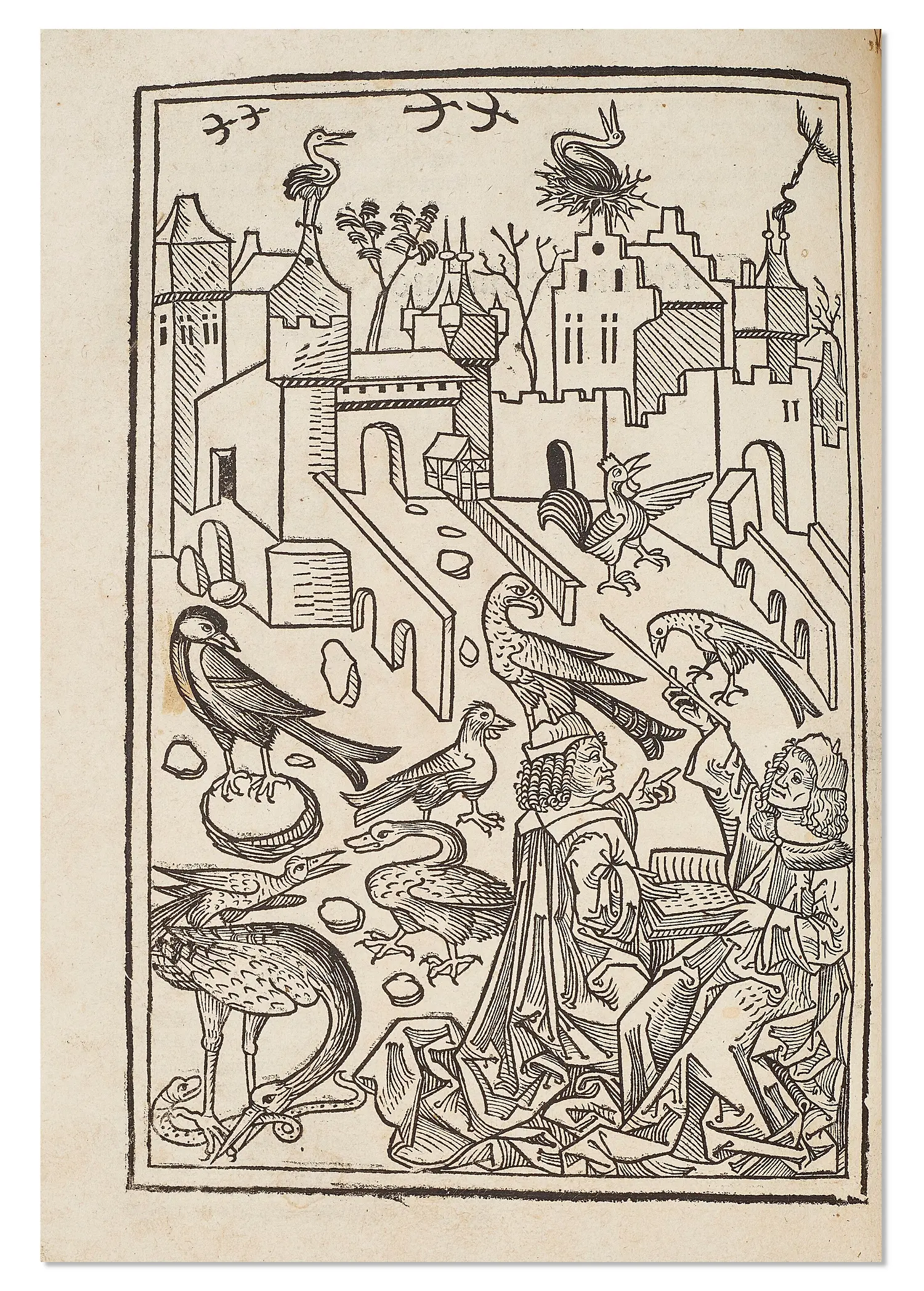 Hortus Sanitatis woodcut from 1491
A penny a head
North of the border, things had already turned. In the mid fifteenth century, King James II of Scotland decreed that kites should be killed wherever possible. England held out for roughly another hundred years, on the basis that the birds were keeping the streets clean, and then Henry VIII got involved.
Under the Tudor Vermin Act of 1532, with a second act following in 1566, parishes paid bounties for the carcasses of animals considered a threat to the nation’s food supply. The background was a run of bad harvests and a fast-growing population, and the solution, as is so often the case, was to find something to blame and put a price on it. A kite’s head was worth a penny, the same as a raven’s, whereas a badger or a fox would get you twelve. I’m not sure what the kite did to be valued at a twelfth of a badger, but here we are.
Over the following centuries the kite was shot, trapped and poisoned, its eggs ended up in collectors’ cabinets, and farmers convinced themselves it was carrying off their lambs (it wasn’t, it mostly eats things that are already dead). London lost its kites some time in the eighteenth century, England lost its last in 1871 and Scotland followed not long after.
At this point, I could get quite preachy about useful things being Written off without a second thought - We regularly see this on a smaller scale, but this was an entire species, and it very nearly didn’t make it back.
Rhayader holds the line
The kite didn’t quite disappear, though. In the steep wooded valleys of mid Wales, a tiny population hung on. By the 1930s and 40s there were fewer than ten breeding pairs left in the whole of Britain, and a long line of farmers, naturalists and conservationists kept watch over them for decades, in what became one of the longest-running efforts to protect a single bird species anywhere in the world.
The man I’d most like to buy a pint is Chris Powell of Gigrin Farm in Rhayader. His family had been putting out the odd bit of food for a pair of kites on the farm, and in the winter of 1993, at the RSPB’s request, Gigrin became an official feeding station. That first winter, six birds turned up regularly. These days Chris drives a tractor into the field and shovels meat off the back for as many as 600 kites a day.
Thirteen young Spaniards
Even with the Welsh birds holding steady, they weren’t spreading anywhere near fast enough to make it back to England or Scotland under their own steam. So in 1989, the RSPB and the Nature Conservancy Council started bringing kites in from abroad. The first arrivals were Swedish, released that year in the Chilterns and the north of Scotland. Then in July 1990, thirteen young kites flown over from the Navarra region of Spain took their first flight above the Chilterns, and that’s when it properly got going.
German birds were brought into Scotland in the mid nineties. Further releases followed in the East Midlands, at Harewood House in Yorkshire, and finally Gateshead in 2004. By 1996, at least 37 pairs had bred in southern England. In 1999 the British Trust for Ornithology named the red kite its Bird of the Century, and by 2020 the RSPB reckoned the UK was home to nearly ten per cent of the entire world population, calling it possibly the biggest species success story in British conservation history.
So, to recap. A native British bird, protected in medieval London, outlawed by the Tudors, kept going by the Welsh and brought home with help from the Swedes, the Spanish and the Germans. If that isn’t Brit-ish, I genuinely don’t know what is.
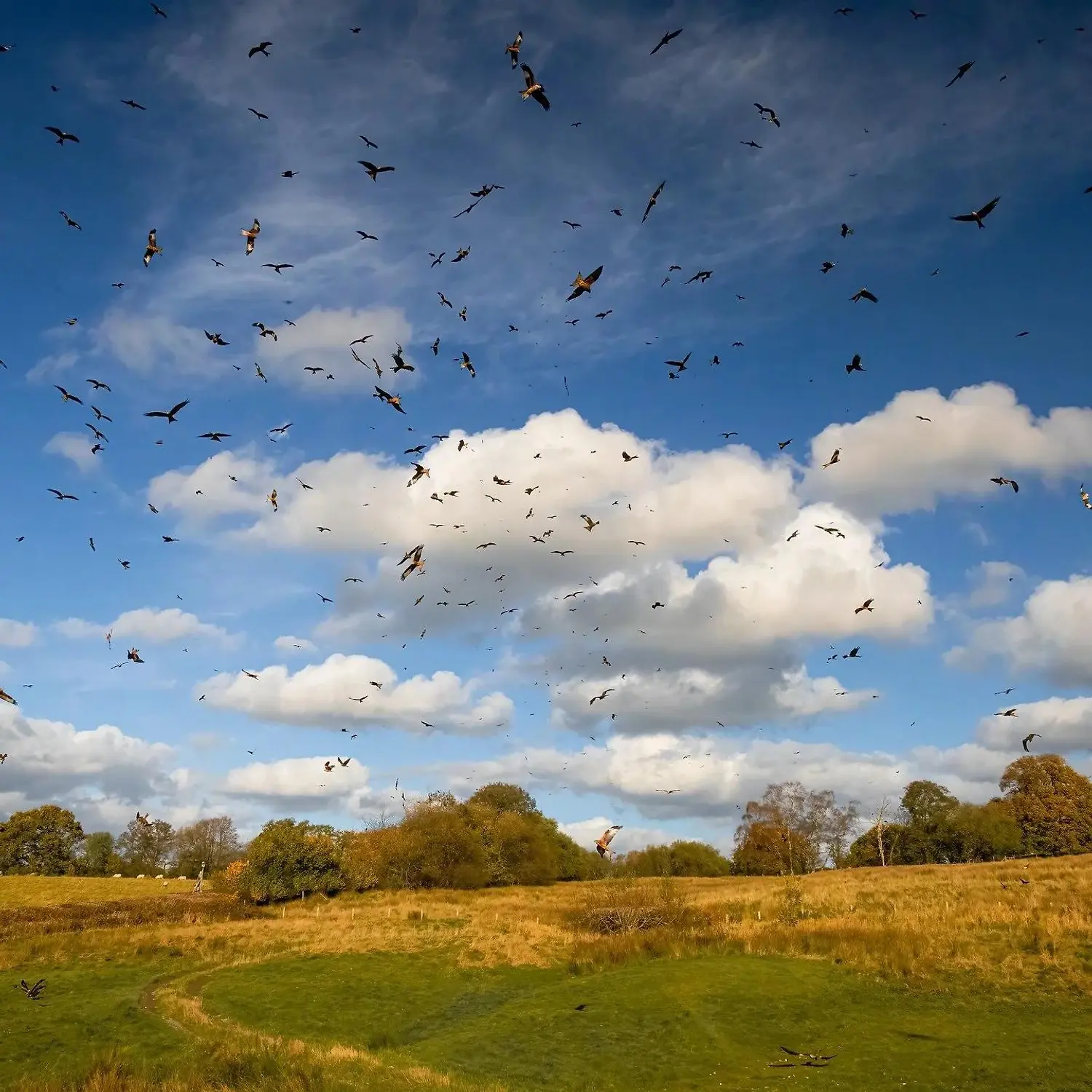 Feeding Time at Gigrin Farm
What it’s actually like
For something with a wingspan close to six feet, the red kite is remarkably easygoing. It’s a scavenger by trade, far happier picking at roadkill and worms than hunting anything that might fight back. It’s sociable, it roosts in groups, and pairs tend to return to the same nest year after year. That forked russet tail is constantly twisting in flight like a rudder, which is how you tell it apart from a buzzard at a glance, along with a thin mewing call that sounds far too small for the size of the thing making it.
Since its return it has also become very comfortable around people. Too comfortable, with countless examples of kites swooping down to take food off unsuspecting passersby. And then there’s the nest building. Remember the Shakespeare line? He was bang on. The RSPB’s list of things found in kite nests includes crisp packets, carrier bags, rags and children’s toys. The Ilkley Gazette reported Yorkshire kites making do with a stuffed rabbit, an England flag and a funeral programme. At Harewood, someone found a tea towel and in Angus, a pair spent two years running pinching socks and underwear from a popular skinny-dipping spot and stashing them in the trees around the nest.
Four hundred years on, the advice still stands. When the kite builds, look to lesser linen.
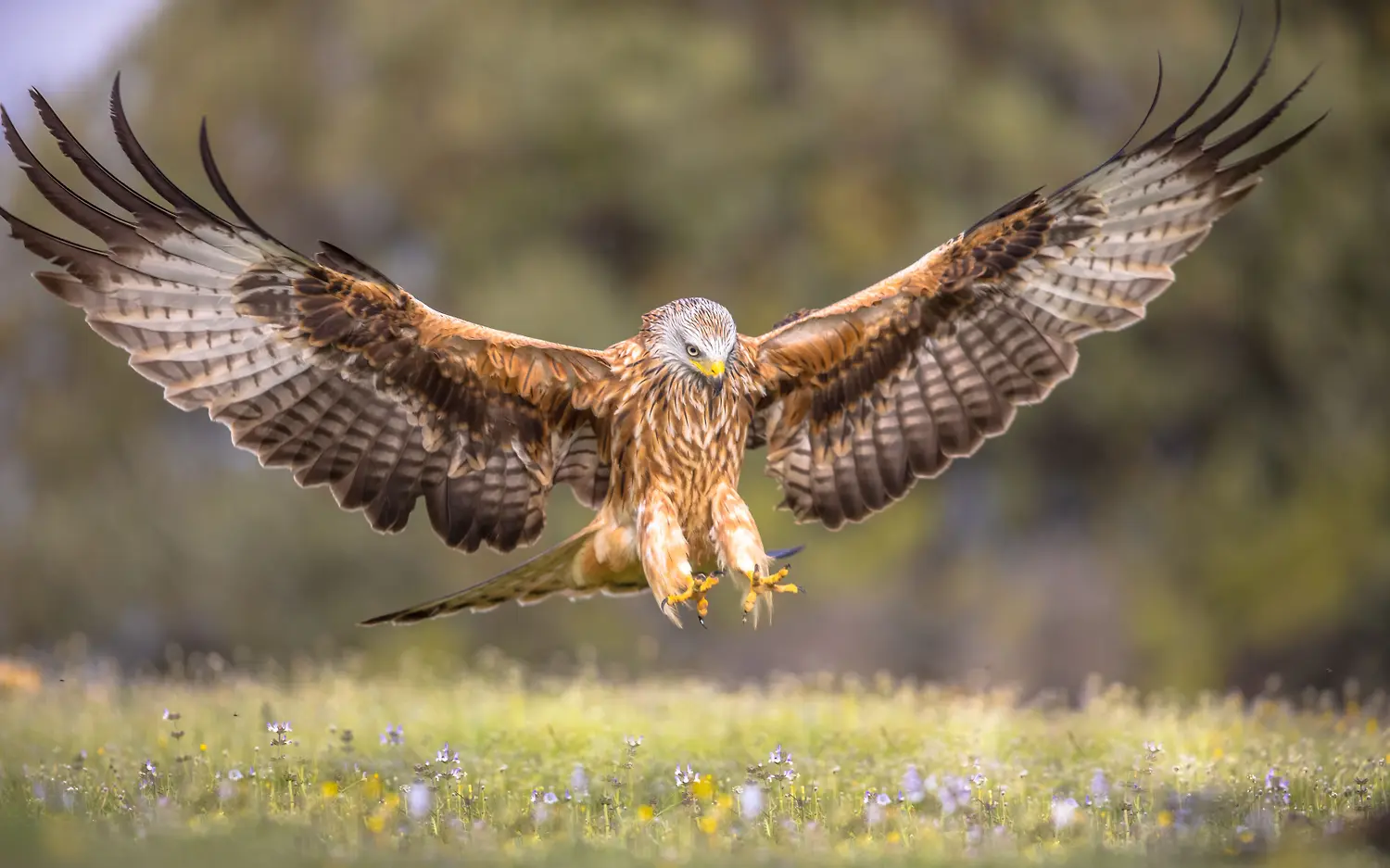 A Red Kite Swooping In
Why it belongs on our logo
Our own story starts in 1870, when John Cheetham, a grocer turned hat maker, opened Cheetham’s Hats in Greater Manchester. Five generations later, the belief that craft matters sits at the heart of our ethos, and the details most people never see are the ones that matter the most.
When I look at the kite now, I see a lot of what we try to do. It’s a working bird that earned its keep for centuries and came very close to being written off entirely. It survived because a few people in Wales wouldn’t let it go, and it got home because the rest of Europe chipped in. These days you’ll find it over motorways, market towns and back gardens, built for the long haul and in no hurry.
So, the next time one drifts overhead give it a nod, and maybe bring the washing in whilst you’re at it.